On Saturday 17 October 2026, ICI writes that the organisers of the mobilisation were calling for “the convergence of anger, against the high cost of living, the price of diesel, the unsanitary premises of National Education or the government’s austerity plans” (translated), with, in Brest, high-school students, university students, unions, parties and yellow vests; “high-school students, now on school holidays, came back to demonstrate” (translated). The Union syndicale des lycéens had called, like several organisations, to join that day the “large demonstration” (translated) of the “yellow vests” (translated) (AFP dispatch of 14 October, picked up by Sud Radio). The prefecture counts 10,000 people at around 2:20 p.m. (ICI); the prefect says the Brest demonstration had not been declared.
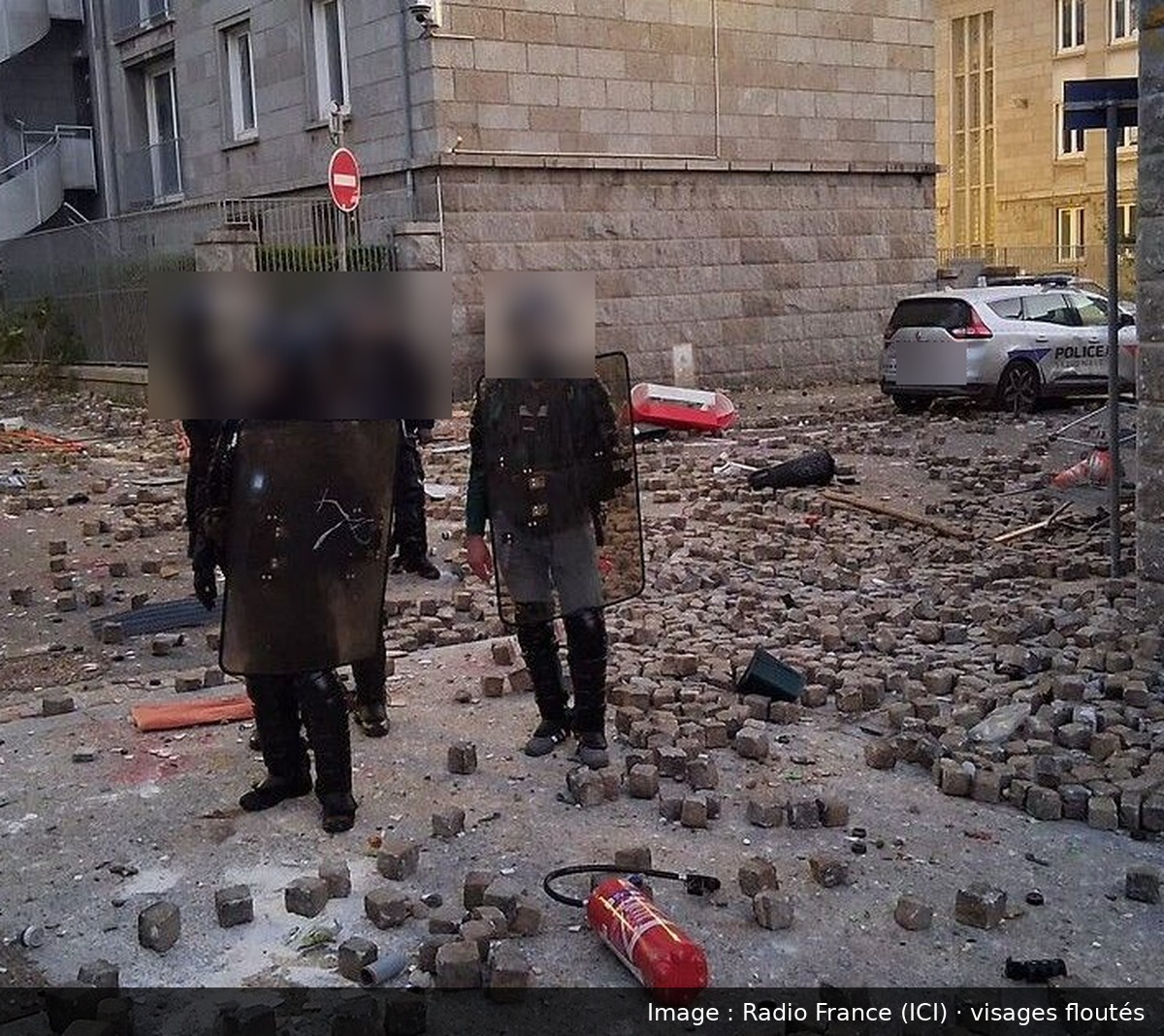
According to ICI, the demonstration “turns into clashes” (translated) as it goes up rue de Siam, at the junction with rue Colbert; at 3:43 p.m., the police fire the first tear-gas grenades to disperse the crowd. Then, for three hours, on both sides of rue Colbert and above all on rue Frédéric Le Guyader, the police officers protecting the central police station come under firework mortar fire and paving stones torn from the ground at the foot of the war memorial; they respond with tear gas “only making it possible to contain the assailants” (translated). Around 5 p.m., paving stones hit a neighbouring dental practice and smash its shopfront (ICI). The prefecture says it requested outside reinforcements; France 3 Bretagne speaks of 1,500 “vandals” (translated) according to the prefecture, for 10,000 to 15,000 protesters.
The next day, the Finistère prefecture draws up a first tally: according to ICI, two police officers had their feet broken “because of paving stones being thrown in Brest” (translated) (the article says neither where nor when: no source read links these injuries to the police station scene, so they are not counted in this case); the prefect tells France 3 Bretagne: “We count 31 injured among the mobile gendarmes” (translated) (for Finistère, with no detail by incident); in introducing the interview with the mayor, ICI writes that the clashes “resulted in about thirty injured among the police forces at the Colbert police station” (translated) (ICI’s own words, overall figure not broken down, retained for the severity of the first fact); according to the prefect, reported by ICI: “They were vandals who were at the head of the marches and who wanted to seriously injure the police officers. Police vehicles were destroyed.” (translated) (claims by an authority about an intention and about vehicles “destroyed” (translated), with no place or detail, which the sources read do not verify); eight people are arrested in the department, seven of them in Brest, out of “1,500 rioters” (translated) according to the prefecture. According to ICI, the prefect says that the State services are gathering photos and videos so that those responsible are brought before the justice system, and he credits the coordination between police officers and gendarmes with having made it possible “to prevent the town hall or the police station from being torched” (translated). The mayor of Brest tells ICI that the “vandals” (translated), numbering about 1,500 and of “quasi-military” (translated) organisation, targeted the sub-prefecture, the court and the town hall and that the town hall narrowly escaped an assault (claims by the mayor, which the sources read do not verify).
The sources read also report the other point of view: some protesters met by ICI say that the violence occurred after shots were fired by the police without warning, and the ecologist group of Brest métropole, which condemns the violence of the protesters, denounces in a statement “disproportionate means” (translated) on the part of law enforcement; France 3 Bretagne reports two injured among the protesters. The perpetrators of the paving-stone throwing are not identified in the sources read.