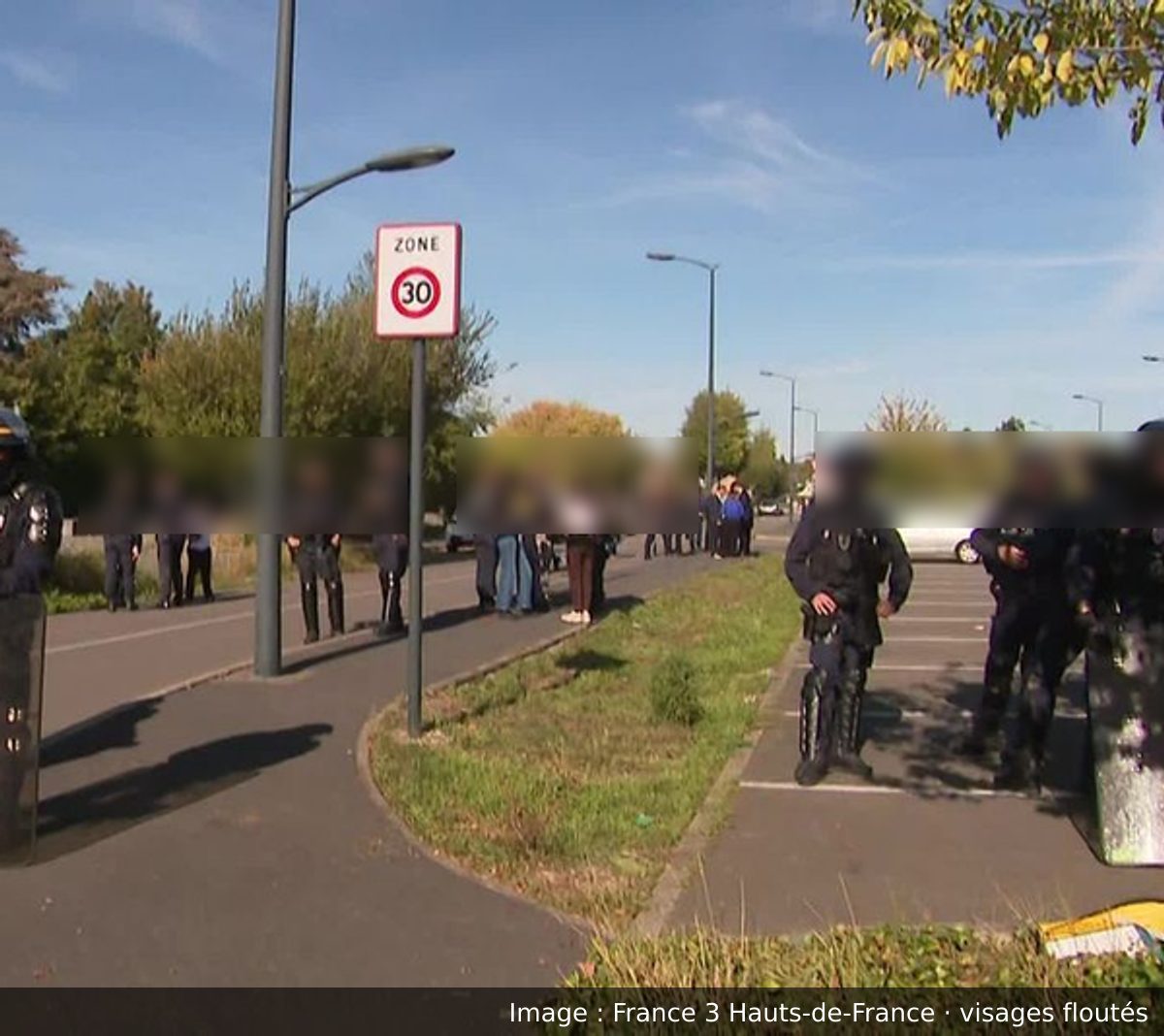
On the morning of Monday 5 October 2026, the high-school mobilisation resumes in the Nord and Pas-de-Calais, with gatherings around the Condorcet and Auguste-Béhal lycées in Lens. CRS riot police disperse the young people with tear gas and grenades (ICI). On rue Alexander-Fleming, a few hundred metres from the Béhal lycée, a grenade explodes in the hand of a 15-year-old (France 3, ICI).
The prefect confirms that a high-school student was “seriously injured during a demonstration” and that “he saw his hand torn off” (translated). The young man is rushed to hospital. The prefect mentions “a group of high-school students, 150 to 200, who threw a whole series of things at the police” (translated) (France 3): remarks that are too general (no place, no time, no link described with the grenade scene, no police injury reported), given here as mere context. In front of the press the same day, the prefect describes “a gathering of 200, 250 high-school students” who threw “stones, fireworks, mortars” (translated) at the police officers and says that “it is in this setting that this event took place” (translated) (franceinfo): a different figure and description from those quoted by France 3, same reservation.
According to a female high-school student quoted by ICI, the students had “started to get gassed when we had done nothing wrong” (translated) while trying to blockade the lycée. Another, who was next to him, recounts: “All of a sudden, he received something near his hand and it exploded. I saw his hand explode.” (translated) The circumstances are disputed. According to a police source quoted by Horizon Actu, the teenager reportedly picked up a grenade thrown by the CRS riot police, which then reportedly exploded. Who threw it is not established. Female high-school students who witnessed it assert the opposite: “They sent it onto us”, “he received it in his hand and all of a sudden it exploded in his hand” (translated) (France 3); “He did not pick it up, he received it on his hand” (translated) (ICI).
Follow-up
The IGPN (police internal affairs) has been called in; the prosecutor wants “all light to be shed” (translated) on this injury (France 3). At a press conference, the public prosecutor of Béthune confirms that an IGPN investigation has been opened and says he cannot establish formally whether the student picked up the grenade or whether it was thrown at him (franceinfo). The Interior Ministry counts this investigation among ten entrusted to the IGPN since the start of the movement (ICI, evening of 5 October). According to ICI (Radio France fact-check, evening of 5 October), the prosecutor referred to the IGPN “the offence of violence resulting in mutilation, permanent disability” (translated). A source close to the case tells ICI Nord that it was a “stun” grenade (translated), whereas France 3 writes “sting-ball”: the sources do not settle the exact type of grenade. The student was taken to the hospital in Lille (ICI). As of 5 October 2026, no charge against a police officer and no complaint from the family were reported in the sources read (situation on 6 and 7 October, then from 9 to 14 October: see below).
On 6 October, according to a local elected official quoted by AFP (franceinfo), the teenager, operated on the day before, had his left hand amputated; the same official also mentions a graft on the other hand and wounds to the face and chest, with no further medical detail. The Béthune prosecutor says on the evening of 6 October that “the first elements of the investigation establish that several grenades were used on the morning of the events after warnings to disperse the gathering, while the CRS riot police were under fire from projectiles and bins were being set on fire: tear-gas grenades, then at least one stun grenade” (translated); no complaint has been filed at this stage and “hearings are continuing” (translated) (Actu17). According to sources close to the case quoted by Actu17, the student reportedly seized the device after it was thrown; a witness interviewed by France 3 gives another version: the grenade reportedly fell directly into his hand. The IGPN investigation is to establish whether he picked it up or whether it fell back on him, and whether the use of the grenade complied with the regulations.
On 6 October, a telegram from the national police director general suspends “as a precaution” (translated) the use of the ASSD grenade projected by launcher, within the high-school movement only and while the circumstances of the injury are established; the Interior Minister announces it publicly on 7 October on RTL (Actu17). A police union denounces this suspension (statement quoted by Actu17). The minister states that the IGPN has been seized of eighteen investigations since the start of the movement (franceinfo, 7 October).
On 7 October, franceinfo (Radio France) publishes a short amateur video that it has authenticated: the stun grenade lands on the ground there, at the feet of two teenagers, and a third teenager, behind them, leans “hand forward” (translated) towards the projectile before leaving the frame; a detonation is then heard. According to franceinfo, the video does not make it possible to assert that he picked up the grenade, but it seems to contradict the account of the witnesses according to whom the grenade reportedly fell directly onto his hand; it was not yet in the possession of the IGPN investigators. The Béthune prosecutor confirms to franceinfo that a CRS officer who had the grenade launcher was heard, for the moment as a witness: he was authorised to fire, but the investigation must determine whether he is the only one to have thrown a stun grenade that day, whether the shot was authorised, proportionate and legitimate.
On 9 October, in a press release, the Béthune prosecutor indicates that the teenager’s mother, heard the day before, “filed a complaint for the injuries suffered by her son” (translated), that the teenager is “still hospitalised” (translated) and will be heard as soon as the medical staff authorise it. According to the first elements of the IGPN investigation, the shot was made “in accordance with the recommended operating procedure” (translated) and the CRS officer “who launched this grenade and for which he is authorised acted on the order of the command authority” (translated); “there is no video available to the investigators making it possible to see the explosion of the grenade” (translated); “all the testimonies (…) with the exception of one converge on the fact that the grenade was fired from a long distance (80 metres) and that it landed on the ground before several protesters approached it and one of them seized it until it exploded” (translated) (franceinfo with AFP). The investigation is still seeking to establish whether the student picked up the grenade or whether the projectile landed on him.
On 10 October, the lawyer for the teenager and his family writes in a press release sent to ICI Nord that her client “formally disputes the version of the facts retained by the public prosecutor’s office: he denies having picked up the grenade that exploded and denies any participation in violence” (translated); the family “is surprised to see the police version already supported by the prosecutor, even though [he] has not yet been heard by the police” (translated) (franceinfo with ICI Nord).
On 14 October, at a press conference in Lille with the Ligue des droits de l’homme, his lawyer announces that the teenager has filed a complaint “for facts of a criminal nature” (translated), for “intentional violence resulting in permanent disability” (translated), with constitution as a civil party: according to franceinfo, this means that an investigating judge can be directly seized in order to open a judicial investigation, whereas a “simple” (translated) complaint triggers a police investigation; no judicial investigation is reported at that date. The teenager was “heard at length” (translated) on 13 October by the IGPN at the hospital where he is still hospitalised; the lawyer says he is in a “very complicated state of health” (translated), his left hand amputated, the right hand “damaged” (translated) and “affected in other parts of his body” (translated), and speaks of injuries that “are akin to war wounds” (translated). His version of the facts: on 5 October, the teenager goes to his lycée, finds it blockaded, picks up “debris of pyrotechnic devices to show his mother concrete proof of his presence and of the police intervention” (translated); shortly afterwards, an explosion occurs, to his left although he is right-handed, and he starts to run “without realising that his hand had been torn off” (translated) before collapsing. The lawyer states: “We were shocked to see that the public prosecutor’s office was championing the police version” (translated); he adds that “the investigation is only just beginning” (translated) (franceinfo). Both versions are written down: that of the public prosecutor’s office (shot compliant; according to all the testimonies but one, a protester seized the grenade, the investigation still seeking to establish whether it was the student) and that of the teenager (he did not pick it up; he picked up debris); the video authenticated by franceinfo does not settle the matter.