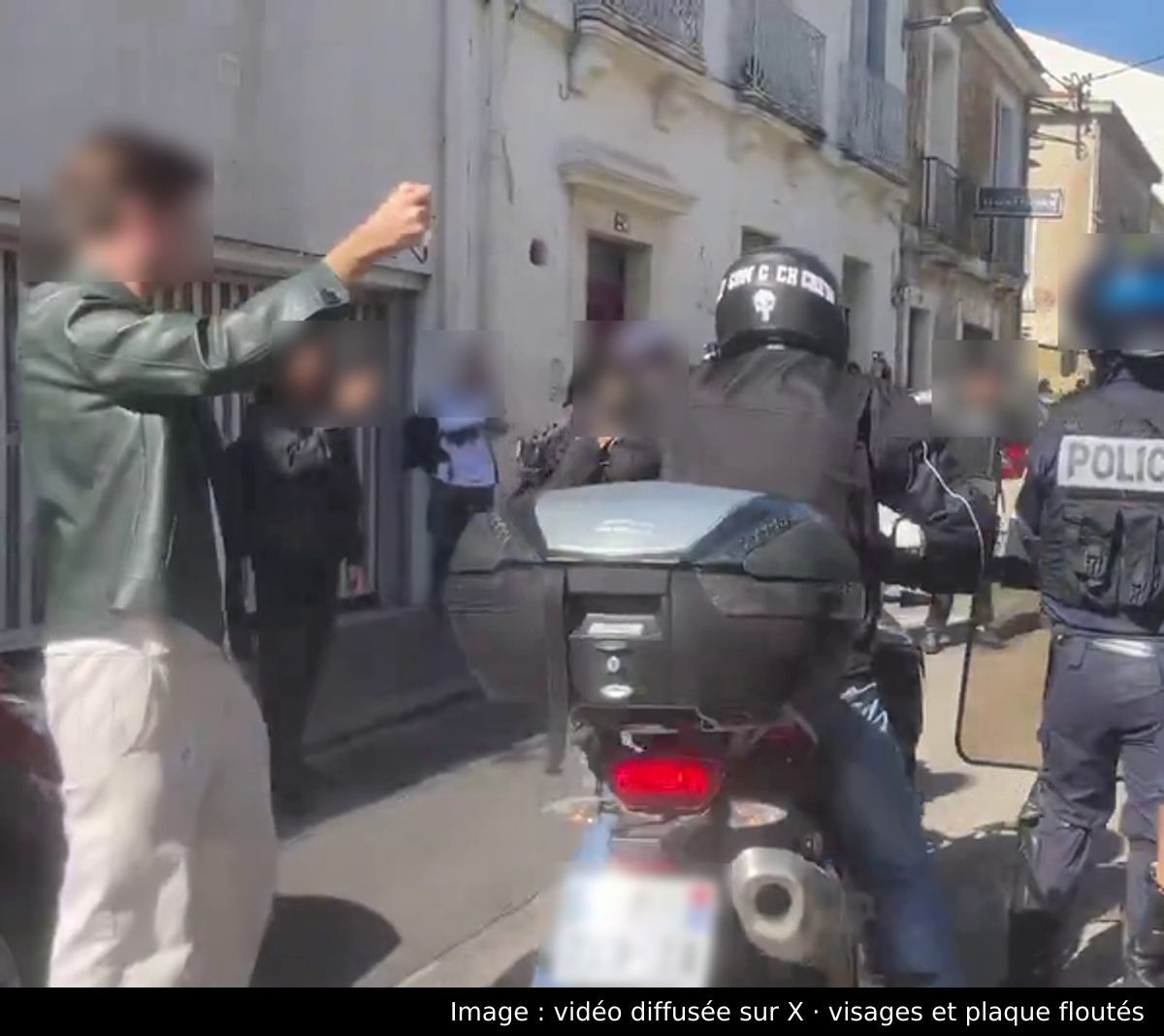
On Friday 2 October 2026, in Montpellier, the prefect of Hérault had had several lycées closed after the previous day’s fires. The same day, in front of the Clemenceau lycée, projectiles thrown and firework mortars fired are reported by several media outlets: see the dedicated entry. The prefecture’s tally, repeated by Actu.fr and InfOccitanie, reports 28 arrests in Hérault, including 13 in Montpellier, and does not mention the journalist.
Le Poing writes that, that day, a journalist who was filming the movement had his leg hit by a police officer on a motorbike, that he was wearing a “press” armband and was identifiable, and that he announced he would file a complaint. A message on X, published the same day, goes further: the police officer reportedly “rode at him deliberately”, was reportedly identified by his superiors, who reportedly encouraged the journalist to file a complaint (translated). As of 5 October, no source read confirmed this last point or reported any reaction from the police or the prefecture (the prefecture’s reply of 2 October: see below). The journalist’s own outlet published on 2 October a video titled “Montpellier: our journalist hit by a police officer on a motorbike” (translated); its description, read only in part, says that he was covering the demonstrations in Montpellier that day. As of 5 October, this was the sole account of the alleged victim, with no independent verification (see below).
The 13-second video shows a street in Montpellier: a group of helmeted police officers, including officers in intervention gear, and a rider with a black helmet parked in the middle of the street, a man filming, and a person in dark clothing at ground level near the motorbike before getting back up. No impact or armband is distinctly visible at this resolution, and nothing indicates the exact place. As of 5 October, the sources did not link the location of the scene and that of the Clemenceau gathering to each other (see below: rue Balard, near the lycée).
Follow-up
On 8 October, the journalist files a complaint with the public prosecutor of Montpellier, against a person unknown, a police officer, for intentional violence by a person holding public authority with use of a weapon, in this case a motorbike; his lawyer asks in particular for the immediate requisition of CCTV and body-worn camera footage. The complaint is accompanied by 16 exhibits, including videos, a witness statement and the medical file; his newsroom condemns the events and reserves the right to become a civil party, and the Club de la presse Occitanie has referred the matter to the Observatoire français des atteintes à la liberté de la presse (France 3 Occitanie). No investigation by the public prosecutor’s office or judicial reaction is reported in the sources read.
Account: according to the journalist’s outlet and his complaint, at around 12:20 p.m. on rue Balard, close to the Clemenceau lycée, a plainclothes police officer on a motorbike places his machine in the line of the camera and says “you, get lost” (translated); as the journalist keeps filming, the rider sets off in his direction, hits him on the right shin, then reverses; the journalist collapses a few metres further on and the scene was filmed by a witness (Le Poing, which cites the journalist and a direct witness). The firefighters make an initial assessment and advise him to see a doctor; the same day, two doctors record a haematoma and skin abrasions and prescribe him sick leave; on 6 October, a third notes injuries consistent with a minor sprain of the right knee; France 3 headlines a 13 cm haematoma (France 3, Le Poing).
The prefecture’s version: on the evening of 2 October, it replies to the Observatoire français des atteintes à la liberté de la presse (Ofalp), which had been approached by the Club de la presse Occitanie, that the journalist “did not comply with the warning” (translated), that “all police officers deployed in the field carry an RIO number” (translated) and that the firefighters “found no injury” (translated) (reply relayed by Le Poing and France 3). The author of the Le Poing article, who was right next to the journalist, says he heard no warning; according to the journalist’s outlet, none is audible on the videos (Le Poing). According to this outlet, the rider had his face masked by a scarf and a dark visor, wore neither an armband nor an RIO, and the police officers present refused to provide his service number; an officer introducing himself as the head of the service said that “the colleague [is] identified” (translated) (Le Poing). The deliberate nature of the act, the identification of the police officer and the message from his superiors mentioned on X are not confirmed by any authority in the sources read.