On Saturday 17 October 2026, the Union syndicale des lycéens had called, like several organisations, to join that day the “large demonstration” (translated) of the “yellow vests” (translated) (AFP dispatch of 14 October, picked up by Sud Radio). France 3 writes that the mobilisations of 17 October took place “under the impetus of high-school students, but also farmers or even Yellow Vests” (translated). In Limoges, the head of the march is “led by high-school and university students in particular” (translated) (Le Populaire du Centre). According to the same newspaper, after nearly two hours of clashes (firework mortar fire, projectiles and street furniture thrown on the one hand, tear gas and sting-ball grenades from law enforcement on the other), the march, “then led by young hooded individuals” (translated), moves towards the A20 motorway. France 3 writes that a police car is set on fire on a slip road of the motorway, then: “Four police vehicles burned in all, according to our information at the end of the afternoon” (translated); the prefect counts five over the whole day (ICI).
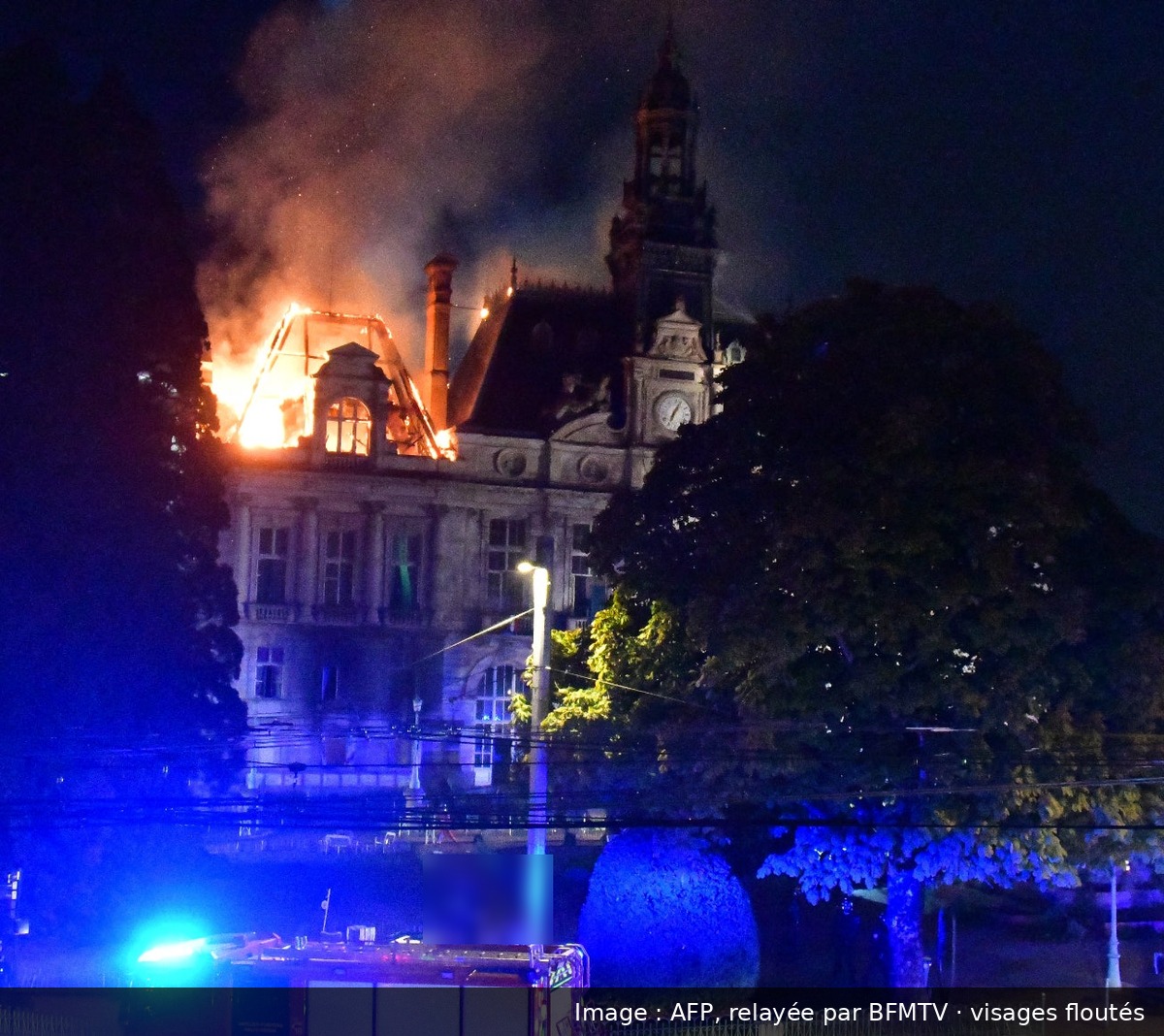
Around 5:30 p.m., according to the account of the prefect of the Haute-Vienne reported by ICI, law enforcement is overwhelmed: “there were about a thousand people with vandals in front of the town hall” (translated). Police officers parked near the town hall are set upon and entrench themselves in the building. Around 6 p.m., according to Le Populaire du Centre, a good hundred individuals arrive outside the town hall: projectiles thrown, windows broken, two police vehicles set on fire. BFMTV (AFP) writes that after burning a municipal police car outside the town hall, hooded individuals broke windows to enter and set fire; Le Populaire du Centre places the start of the fire on the ground floor at 6:15 p.m., with “young individuals” (translated) infiltrating the premises of the town hall, “ransacked in a few minutes” (translated), while the police had entrenched themselves there.
According to the prefect, cited by ICI, the individuals who entered “started setting fire in the basements and on the ground floor” (translated) then “also went up to the upper floors to set fire” (translated); he states that two security guards of the town hall were “threatened with death” (translated) and that the fire was set “while they knew that there were elected officials and members of the public in the building” (translated). According to ICI, without saying that the fire was premeditated, the prefect indicates that the arsonists knew the premises; on LCI, he says: “The fire was set knowingly” (translated) (BFMTV). The firefighters arrive shortly after 6 p.m. (France 3). The fire reaches the roof around 7 p.m. and the campanile collapses around 8:30 p.m. (France 3, Le Populaire du Centre). At the height of the fire, 80 firefighters fight the flames; according to the prefect, people at the rear throw projectiles at the firefighters and law enforcement, and some even “applauded and whistled with satisfaction when parts of the building collapsed” (translated) (ICI).
In the evening, the prefect and the mayor say the town hall is “very heavily damaged” (translated) and “largely lost” (translated); the prefect specifies: “The roof collapsed onto the lower floors, except in the west wing, and two thirds of the facade have already disappeared” (translated) (AFP via BFMTV). The mayor declares: “They destroyed a building that the people of Limoges love, but they did not destroy the public service. It is a monument that is burning, but not the Republic” (translated) (ICI). The next day, the fire is contained and, according to the prefect, “the whole back of the town hall was saved” (translated) (ICI). The departmental director of the firefighters tells ICI Limousin TV that the rescue teams “still saved four fifths of the building” (translated) and still fear the collapse of the chimneys and the campanile, while France 3 writes that “the whole front part of the building went up in smoke” (translated) and that the two lateral gables are now only shells: the sources read do not agree on the extent of what was saved. The Prime Minister writes to the mayor that the town hall “will be rebuilt” (translated) (France 3).
Follow-up
The Limoges public prosecutor indicates on 18 October that an investigation is opened for “destruction of property by means dangerous to people, by an organised gang” (translated) (up to twenty years of criminal imprisonment), entrusted to the organised crime division of Limoges, which is examining surveillance cameras, police drone images and social media images (ICI). Seventeen people, including seven minors, are placed in police custody, but for looting of shops: “for the moment, they are not suspected in the case of the town hall fire” (translated) (ICI). The public prosecutor’s office adds that “private individuals were also set upon, sometimes violently” (translated) on the margins of the gatherings and that a count of the victims is going to be made (BFMTV).